
Teleflow
Three Product Hunt Launches. Three Very Different Audiences.
What Teleflow, MTL Exits, and Bora Praia reveal about launch visibility, useful feedback, and finding the right people on social media—with a practical promotion plan.

The launch page is live. The screenshots look good. You refresh the score. Then comes the harder part: finding people who actually need what you built.
Teleflow, MTL Exits, and Bora Praia all made it onto Product Hunt. As checked on September 6, 2026, their pages displayed 3, 1, and 1 points respectively. Those are the platform’s displayed scores at the time of review, not install counts or a reconstruction of launch-day rankings. They are also a useful starting point for an honest launch story.
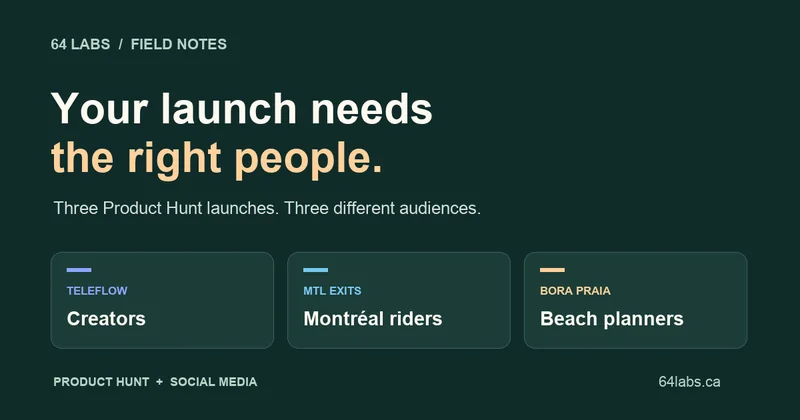
A creator trying to record a tutorial, a visitor navigating Montréal’s metro, and a family deciding when to leave for the beach have very different reasons to care about an app. A shared launch platform does not give them a shared audience.
That distinction feels especially relevant this week. In a September 1 report, Social Media Today described LinkedIn’s increased enforcement against inauthentic activity, including artificial engagement. Meanwhile, its September 3 coverage of Reddit’s expanded Max campaigns showed how much easier paid social promotion is becoming to automate. These are platform developments, not evidence about the performance of our apps. Our takeaway: the ability to distribute a message is increasingly accessible; the judgment to put a useful message in front of the right people still matters.
Where launch promotion actually happens
Founders publish demonstrations, explain the problem that led them to build, share progress, answer comments, and invite people to try a specific workflow. Some work with creators or buy social ads. Others participate in established communities. Product Hunt’s own promotion guide recommends building a presence before launch, sharing through social channels, and staying available for feedback.
For a small team, choose one primary social channel and one supporting channel. The following is an audience-based starting plan, not a ranking of platforms by market share:
- LinkedIn: explain a professional problem and show a short demonstration. It is a sensible place for Teleflow’s founder story and people making product demos. For MTL Exits, a professional audience may offer contacts and feedback, but many readers will never ride the Montréal metro.
- X, Threads, and Bluesky: use progress posts and replies to talk with makers and early adopters. Share one specific discovery or improvement per post, with a clear route to trying it.
- Instagram Reels, TikTok, and YouTube Shorts: show the outcome before explaining the app. Teleflow can demonstrate a scripted take; MTL Exits can demonstrate a car-and-door result; Bora Praia can demonstrate a departure time.
- Facebook groups and Reddit communities: start with a relevant local or activity-specific problem. Check each community’s rules, disclose that you made the app, and contribute useful information before sharing a launch link.
Product Hunt gives curious people a place to inspect the product and talk to its maker. A social post can send them there when feedback is the goal, or to the public product site when trying the app is the goal. Give each post one clear next action.
Case study 1: Teleflow makes the founder’s problem easy to recognize
Launch setup. Teleflow’s Product Hunt page presents a local teleprompter for recording selfie videos, with a gallery, product and store links, and a maker introduction. Felipe explains that recording demos for his own apps meant forgetting lines, looking away at notes, and repeating takes.
The implemented workflow supports that story. In Teleflow, you write or choose a locally saved script, adjust text size and scrolling speed, rehearse in Preview mode, and optionally record a selfie clip with microphone audio when permissions are available. The finished clip can be saved to the device. There is no account or cloud-sync setup.
Promotion activities. Felipe also published a LinkedIn launch announcement describing the problem, naming demos, tutorials, and short social videos as use cases, and linking to Product Hunt and the download destination. A public LinkedIn repost preserves that announcement. On Product Hunt, he replied to questions about longer scripts and the consequences of keeping scripts locally.
Results. The page showed 3 points and 11 followers when reviewed. Public comments asked about long-script scrolling and larger text, and praised previewing the read. These are individual comments, not independently verified performance tests. Attributed visits, installs, and retention were unavailable for this article.
Lesson and next step. A familiar frustration gave people something concrete to discuss. For the next social sequence, record a short demo showing script, preview, and finished take. Turn the long-script question into a measured demonstration, with the script length stated, rather than promising that every recording will be effortless.
Case study 2: MTL Exits needs riders with a real destination
Launch setup. The MTL Exits launch page focuses on choosing the right car, door, and exit in Montréal. Its gallery and maker comment explain route selection, transfer positioning, and street exits. The introduction also asks which other cities need similar guidance.
MTL Exits implements route planning and exit alignment using station, train-direction, car, and door data. Riders can select a supported street exit and see where to board. Core route and exit guidance works offline after installation. That is a specific promise a social demonstration can make visible.
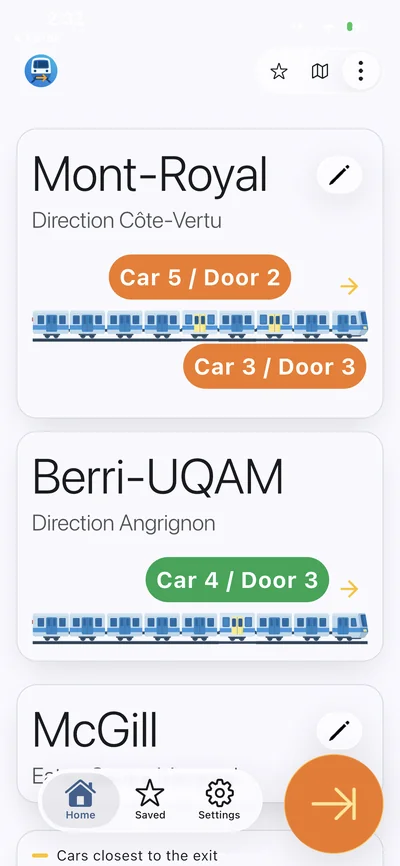
Promotion activities. The documented launch activity includes the maker’s introduction and an invitation for Montréal riders to test a real route and report unclear or incorrect guidance. The separate invitation to transit-data contributors broadens the discussion. The project also contains a planned local demonstration sequence. A verified record of published social posts or creator placements was unavailable, so that plan should not be counted as completed promotion.
Results. The launch page showed 1 point, 2 followers, and no reviews at the September 6 check. The visible conversation contained the maker’s introduction. Those observations tell us little about actual ridership or installs; no attributed acquisition results were available.
Lesson and next step. The audience hypothesis to test is geographic relevance. Make a short English and French demonstration around one supported Montréal journey. Open with the destination, show the selected exit and car-and-door result, and invite riders to try their own route. Share it in appropriate local social communities and with a Montréal creator whose audience actually uses transit. Measure route trials and useful corrections, not worldwide impressions alone.
Case study 3: Bora Praia gives people a plan they can show
Launch setup. Bora Praia’s launch leads with the practical question of when to leave. Its gallery and introduction describe choosing a place, preferred conditions, travel time, and stay length to get an outing window and departure time.
The current Bora Praia project implements that planning flow and exposes the conditions behind its recommendations. It also contains a social image composer and a shared-plan workflow. These make the result useful as social content: show the actual plan produced by the app, with the place, date, and assumptions clear. A suggested window is not a guarantee of safe swimming or ideal weather.
Promotion activities. The Product Hunt maker introduction explains the multi-source planning problem and the app’s handling of unsuitable forecast windows. The project’s August 30 acquisition package also prepares a local creator pilot and a 20-second demonstration sequence. That is evidence of preparation, not evidence that creators were contacted, posts ran, or campaigns converted.
Results. At review, the page showed 1 point, 3 followers, and no reviews. No attributed campaign traffic, completed-plan totals, or retention results were available. The existence of measurement code does not establish a campaign outcome.
Lesson and next step. Demonstrate one beach decision. A local creator can choose a supported beach, show their preferences and recommended departure, then explain how the visit compared with the plan. For an initial organic test, use a Reel or TikTok plus a relevant local Facebook group. Keep claims tied to the actual forecast and distinguish a recorded example from current conditions.
A social promotion timeline you can run
Use launch day as the center of a short campaign. The schedule below is a recommendation for the next launch, not a claim about what these three campaigns already did.
- Days −14 to −8: find the audience. Pick one user, one problem, and two social channels. Publish two useful posts about the problem and answer replies. Note the language people use. Confirm Product Hunt account eligibility early; its pre-launch guide says new accounts must wait one week before posting a product.
- Days −7 to −3: make the proof. Prepare one 20–30-second vertical demonstration, three real screenshots, and a concise founder post. Put the outcome in the opening seconds. Finish the Product Hunt gallery, product links, and first maker comment using its preparation guide. Ask a few relevant testers to attempt the demonstrated task and fix confusing steps.
- Days −2 to −1: check the handoff. Preview the launch listing, test links on a phone, and confirm the launch time shown by Product Hunt’s scheduler. Prepare distinct captions for each social channel. Set a primary outcome and record the previous week’s baseline. If you use campaign links, verify that the destination actually records their labels.
- Launch day: demonstrate and converse. Publish the main demo and founder post when the intended audience is active. Pin the relevant launch post where the platform supports it. Set aside three reply windows across the day; answer practical questions with screenshots or short clips. Tell consenting testers the launch is live and invite honest feedback.
- Days +1 to +3: answer the strongest question. Publish a follow-up demonstration addressing something people actually asked. Explain any limitation plainly. Share a useful response or testimonial only with permission, and make compensated creator relationships clear.
- Days +7 and +14: report and refine. Compare channels, completed tasks, and repeated use where measurable. Post one concrete finding and the change it prompted. Continue the format that brings relevant trials; revise a post that draws views but no meaningful action.
A simple launch caption can follow this pattern: “I kept running into [specific problem], so I built [app]. Here is [one real workflow] in 20 seconds. Try it and tell me where it feels unclear.” Keep the demonstration specific enough that someone can decide whether it is for them.
Product Hunt explicitly says to ask for feedback rather than upvotes. Avoid vote exchanges, rewards for voting, mass unsolicited messages, and copy-pasted replies. Familiarity comes from useful participation; an engagement pod cannot supply evidence that the product helped someone.
Measure the journey from a post to a useful outcome
Keep a small scorecard for each post: channel, date, audience, creative, destination, impressions, outbound clicks, and the next meaningful action you can actually observe. Record Product Hunt points and comments separately.
- Attention: impressions and video completion, compared within the same platform and format.
- Intent: outbound clicks and relevant questions. Click-through rate is outbound clicks divided by impressions; state the platform’s definition and reporting window.
- First useful outcome: a recorded take for Teleflow, a real route checked for MTL Exits, or a completed beach plan for Bora Praia.
- Return: another take, another trip, or another plan during a defined follow-up window, where you have permission and a reliable way to measure it.
These are recommended success measures, not a claim that all three apps automatically report them. For a local tool such as Teleflow, use aggregate store reporting and voluntary tester follow-ups without collecting private scripts or recordings. Mark unobservable steps as unknown. A campaign parameter on a website link does not automatically connect that visit to an app install.
For a small first test, an example goal is ten relevant people completing the core task within seven days and three actionable observations. Choose your own target before posting. Ten completed trials are more informative than ten congratulatory comments, but neither establishes long-term retention.
Influencer reach or product quality?
Reach affects how many people encounter the promise. Audience fit affects how many care. Product quality affects what happens when they try it.
A large creator can introduce Teleflow to people who record regularly. A smaller Montréal transit account may be a better match for MTL Exits than a much larger general technology account. A coastal creator who shows a real planning decision may give Bora Praia more useful exposure than an attractive beach montage. These are hypotheses to test through relevant visits and completed tasks, not guaranteed performance advantages.
Before arranging a collaboration, check who the audience is, where it lives, whether the comments relate to the subject, and whether the creator can honestly demonstrate the workflow. Agree on the demonstration and reporting. Avoid anyone promising votes or a leaderboard position; Product Hunt also warns against paying people to hunt a product.
If the core task is confusing, fix it before amplifying the problem. If people complete it and want to return, improving distribution becomes the next useful experiment. A low Product Hunt score alone cannot tell you which situation you are in.
For your next launch, choose one useful moment to show: the take you can finish, the door you can board by, or the departure time you can plan around. Find the people who recognize that moment. Give them something real to try, and stay for the conversation afterward.
Research note: Recent coverage was reviewed for August 23–September 6, 2026. Launch observations come from the linked public Product Hunt pages and Teleflow announcement, checked September 6; product descriptions were checked against the apps’ current project implementations. Public scores and follower counts may change. Where social activity or acquisition results could not be verified, that limitation is stated. Recommendations are editorial analysis, not measured outcomes of these launches.