
MTL Exits
The Montréal Metro Is Turning 60. This App Finally Tells You Where to Stand.
MTL Exits tells you where to board—and its platform walking timer helps you reach the right door before the train arrives.


This fall, Montréal is celebrating six decades of life underground.
The STM has launched festivities for the métro’s 60th anniversary on October 14 under the theme “60 years of métro-moments.” Montréalers are being invited to contribute their own memories: first rides, late-night trips home, chance encounters, daily commutes and all the other moments that have unfolded beneath the city. (Société de transport de Montréal)
But there is one métro-moment that probably will not make the commemorative montage.
The train pulls into the station. The doors open. Everyone streams onto the platform—and you discover that you are at the exact opposite end from your exit.
Now you are speed-walking behind a wall of backpacks, trying to pass people on a narrow staircase and wondering how the riders at the front somehow knew exactly where to stand.
That little Montréal ritual is what MTL Exits was built to eliminate.
Getting to the station is only half the journey
Most transit planners are focused on the big questions: Which line should you take? Where should you transfer? When will the next train arrive?
MTL Exits focuses on what happens after those questions have been answered.
Because reaching the correct station does not necessarily mean reaching the correct place. A station may have multiple exits leading to different streets, intersections, buildings or underground corridors. Choose the wrong one and the final minutes of your trip become an unnecessary detour.
MTL Exits lets you choose your departure and destination stations, compare available routes and see where you should board. Its train diagrams identify the recommended car and door, the direction of travel, transfer positions and, where available, the street-level exit that makes the most sense for your destination. (Download MTL Exits)

In other words, it plans the trip with the exit already in mind.
That can mean stepping off beside the staircase you need instead of taking the scenic route through three corridors, two flights of stairs and a mildly confusing underground shopping centre.
The feature that turns advice into action
Knowing the best door is useful. Reaching it on a long platform is the next challenge.
That is where the MTL Exits walking timer comes in.
When you arrive on the platform, tell the app which entrance brought you in. MTL Exits compares that position with the train door recommended for your destination. It then provides a walking direction, an estimated number of steps and an estimated walking time.
Tap Start Walking, put your phone away and begin moving along the platform.
The countdown continues while you walk. Once you have reached the estimated position in front of the recommended door, the app tells you to stop. With notifications enabled, it can deliver a local alert, along with a vibration cue when the timer finishes. The app’s current listings describe platform guidance with estimated steps and walking time, plus an optional local countdown alert. (Download MTL Exits)
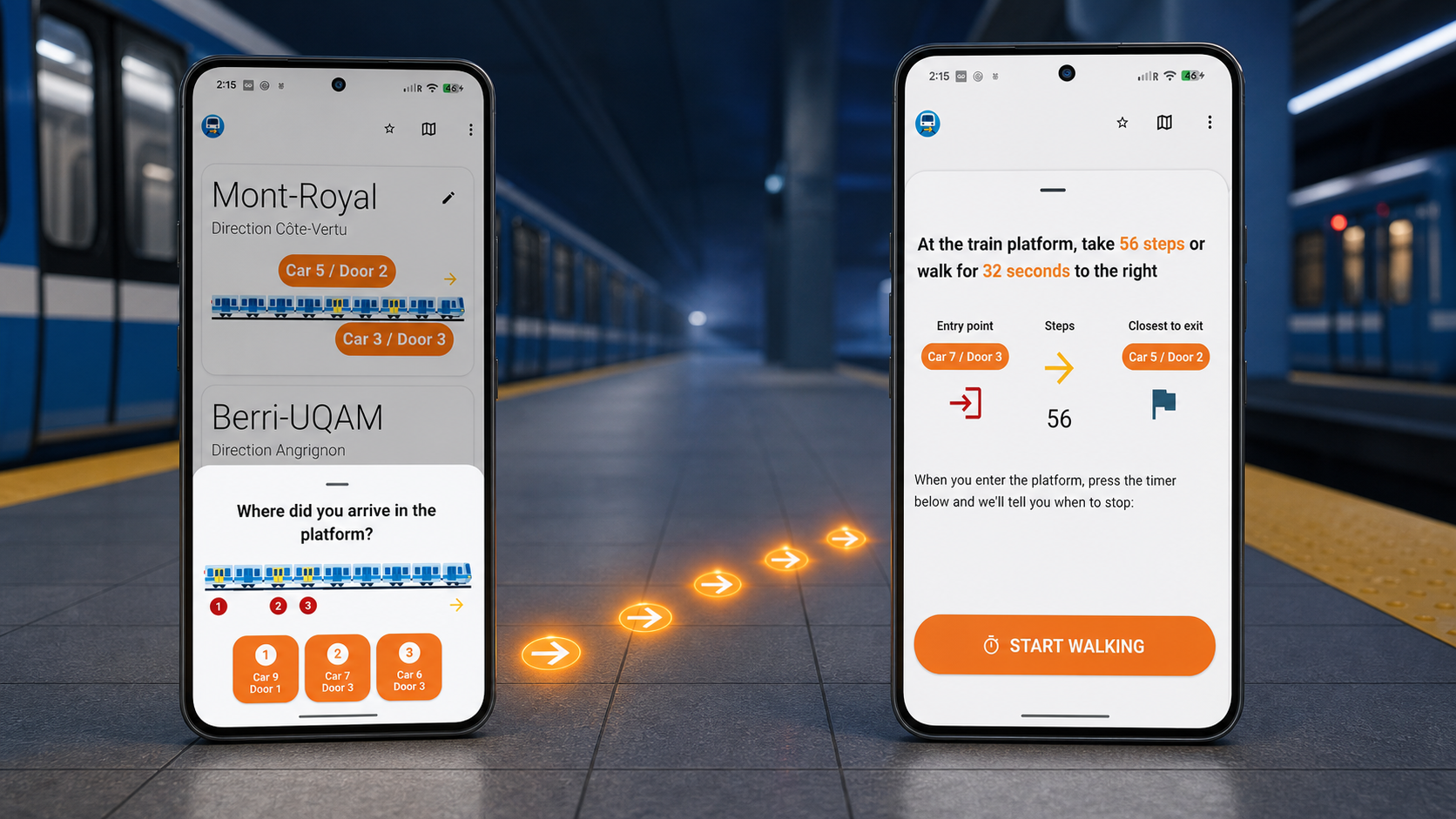
It is a little like having a métro-savvy friend in your pocket:
“Keep going … keep going … perfect. Stand here.”
Then the train arrives, the doors open and you board in the position that should put you closer to the exit at the other end.
A positioning guide—not imaginary indoor GPS
The walking timer is intentionally practical about what it can and cannot do.
It does not track every step in real time. It does not claim to know your exact walking speed. It does not pretend that reliable indoor GPS suddenly exists several levels beneath Montréal.
Instead, it uses the estimated distance between your platform entrance and the recommended train door to calculate a reasonable walking time.
A fast walker may arrive slightly early. Someone moving more slowly may need a little longer. Crowded platforms can also change the pace. The timer is not trying to map your exact movement; it is giving you a useful reference point so that you do not have to count doors, study the entire platform or keep checking your phone.
It is a positioning guide designed for the messy reality of public transit.
A small improvement that changes the whole trip
Montréal’s métro is simultaneously celebrating its history and building its future. The STM recently announced that vertical excavation had been completed at two of the five future Blue Line stations: Mary-Two-Axe-Earley and Cesira-Parisotto. (Société de transport de Montréal)
Those are major projects. But not every useful transit improvement needs to involve a tunnel-boring machine.
Sometimes the improvement is simply knowing where to wait.
For a daily commuter, that can make the morning feel a little more controlled. For an occasional rider, it removes one of the network’s recurring uncertainties. For someone carrying groceries, travelling with children, rushing to an appointment or navigating an unfamiliar station, avoiding the wrong staircase can make a surprisingly large difference.
And on a transfer trip, the right position can help you arrive closer to the passage leading to the next line rather than joining a last-minute platform migration after the train stops.
The benefit is measured in only a few minutes at a time—but those are often the most irritating minutes of the journey.
Built for the reality underground
MTL Exits also supports direct and transfer routes, recent and saved trips, custom labels, Home and Work shortcuts, nearby-station suggestions and a zoomable métro map. It is available in English and French.
Core route and exit guidance works offline after installation, so the app remains useful when cellular service underground becomes unreliable. No account is required, and location access is optional; when enabled, it is used on the device to suggest nearby stations. (Download MTL Exits)
That matters because a métro tool should not become useless at the exact moment you descend into the métro.
Plan beyond the arrival time
Transit apps have become very good at telling us when we will reach a station.
MTL Exits asks the next question:
When the doors open, where do you actually want to be?
The answer may be near a particular street, beside the right staircase, close to your transfer or simply at the end of the platform that saves you from an avoidable underground hike.
Choose the trip. Select the exit. Enter the platform. Start the timer. Walk until the app tells you to stop. Board at the recommended door and arrive closer to where you are really going.
Because nobody takes the Montréal métro hoping to add five unnecessary minutes of underground walking to the journey.
MTL Exits is available for iPhone and Android. (Download MTL Exits)