
MTL Exits
If Everyone Boards for the Fastest Exit, Does Anyone Get Out Faster?
Google Maps showed me where to board in Paris. For Montréal riders, the interesting question is what happens when many people follow the same advice—and when a different door makes more sense.

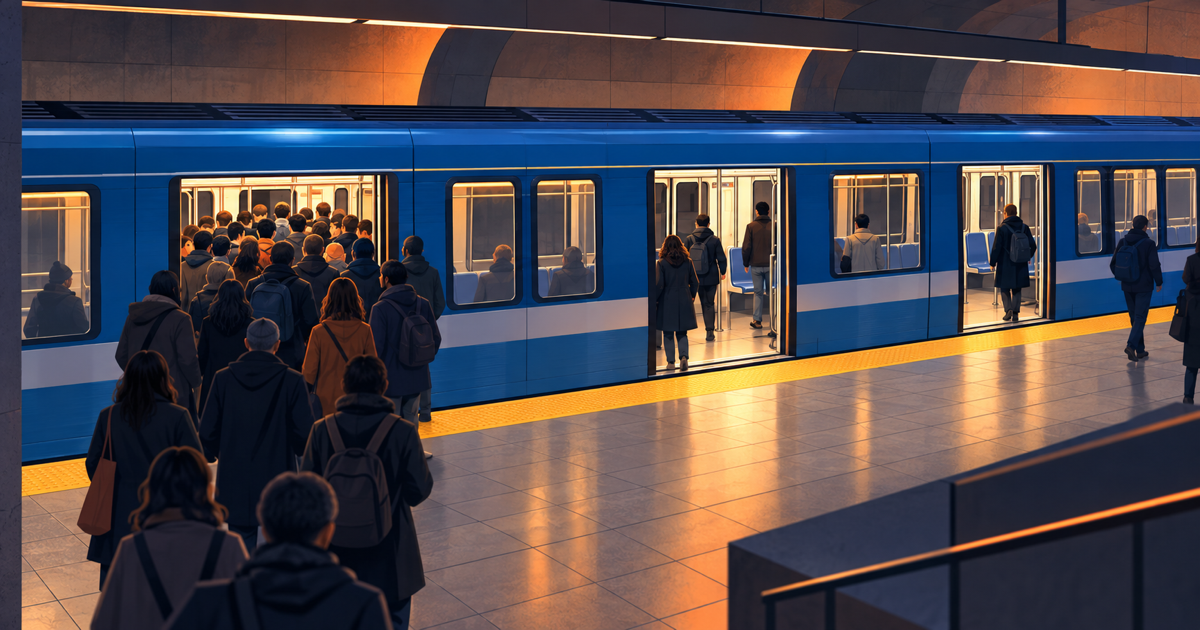
In Paris recently, Google Maps showed me a small instruction I wish every métro rider had when visiting a new city: “Board position for fastest exits.” Then I wondered what happens when everyone gets the same tip.
It is a useful idea. If your destination is beside a staircase at the far end of the platform, boarding near that staircase can spare you the walk after you arrive. Similar Google Maps boarding-position advice has been reported by riders in Tokyo and other cities. But a recommendation that works for one passenger does not automatically improve the flow of a whole train.
The shortcut has to start somewhere
Imagine twenty people on a platform heading to the same downtown exit. A trip planner points all twenty toward the same car. They walk before boarding instead of after arriving, which could make each arrival simpler. Yet they may also queue at the same doors while space remains in the next car. When the train reaches the destination, those twenty people all head toward the same staircase.
This is a thought experiment, not a prediction about Montréal. The result depends on where people entered, which exits they need, how full each car is, and whether they can move safely along the platform. Riders who are already near the recommended door may benefit most. Someone who would have to push through a crowd to reach it may be better off boarding where there is room.
The wider question has real research behind it. A University College London study of London Underground boarding patterns found that knowledge of destination exits influences where passengers wait, and that their distribution affects train dwell time. Its model estimated that, on average, 60% lined up around cars closest to exits at their arrival stations. That is a London finding, not a measured Montréal outcome. It suggests that the “everyone” scenario begins well before everyone opens an app: many regular riders already know their preferred car.
Why this matters in Montréal this week
The UCI Road World Championships began in Montréal on September 20. The event’s travel guidance points visitors to transit while road closures change how people reach venues. For an occasional rider, “which station?” is only the first question. “Which street exit?” can determine whether the last part of the trip is straightforward or a detour.
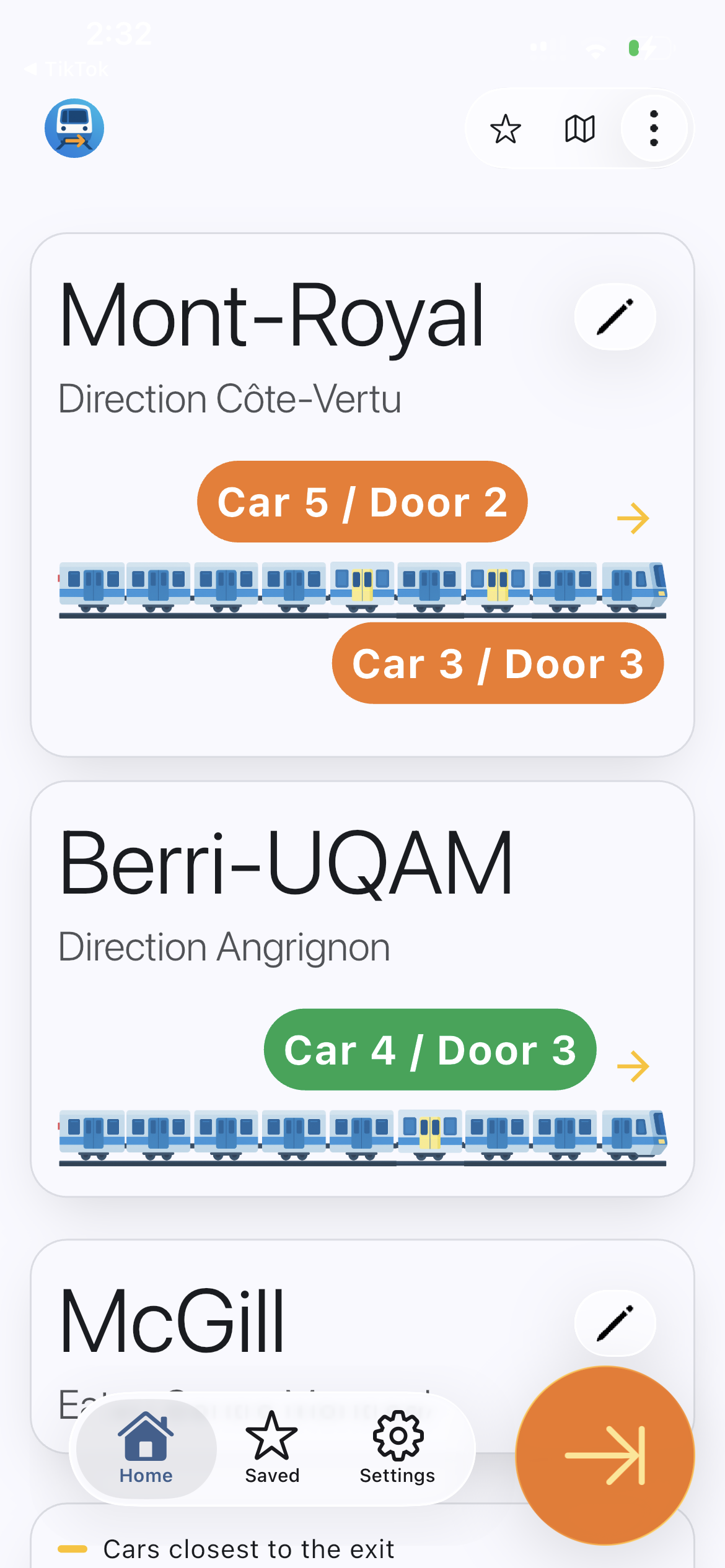
That is the specific job of MTL Exits. Choose departure and arrival stations, then a supported street exit when the destination has options. The app shows the train direction and recommended car and door; routes with transfers include positioning for the next leg. Its platform guide can estimate how far to walk from a selected entrance to the suggested boarding spot. Core route and exit guidance uses bundled data, so it works offline after installation. It does not show live car crowding or calculate a system-wide passenger distribution.
Will Google bring the same cue here?
Possibly, but I would not plan a Montréal trip around an unannounced feature. Google said in 2023 that Maps showed station entrances and exits in more than 80 cities, including Paris, Tokyo, and Toronto. That is a different feature from telling you which car to board. I have not found a public Google timeline for bringing the boarding-position cue to the Montréal métro, and I do not know how many Maps users act on it where it appears.
If it does arrive, it could make a useful habit easier to discover. It could also make the busiest recommended doors more obvious to everyone. Both effects deserve observation rather than a confident claim that every trip, or every train, becomes faster.
A practical rule for your next trip
Check the exit you actually need before choosing a boarding position. If the suggested car is reachable and the queue is reasonable, use it. If that doorway is packed, leave room for people getting off and consider a nearby door. A saved walk at the destination is rarely worth a difficult or unsafe boarding attempt.
That is the spirit behind MTL Exits: give riders a concrete car-and-door answer, then let them use judgment on the platform they can see. The fastest exit is helpful information. It is not an order to join the longest queue.
Research note: Recent Montréal event coverage and travel guidance were checked on September 23, 2026. The Paris observation is firsthand; reports from other cities are rider accounts, not a Google rollout announcement. The London study concerns its own network. No Montréal-wide crowding or Google Maps adoption effect is claimed here.