
Teleflow
Google Just Put a Teleprompter in the Pixel 11. That Could Be the Best Thing to Happen to Teleflow.
Google made the teleprompter a native Pixel camera feature. That raises the standard for Teleflow—and may introduce millions of creators to the problem it solves.

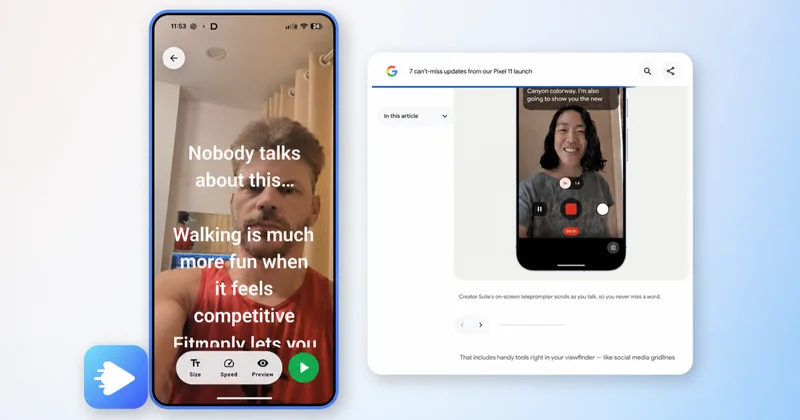
When a phone maker turns a niche creator tool into a standard camera feature, it does not necessarily eliminate the category. It teaches millions of people why the category matters.
Correction — September 6, 2026: The original version incorrectly described Teleflow as a prompting-only app. Its current mobile implementation supports selfie video recording with microphone audio and saving clips to the device. The Teleflow comparison below has been corrected; the original August 23 publication date and Pixel launch context are retained.
Most smartphone launches promise better footage: sharper zoom, brighter night shots, smoother stabilization.
With the Pixel 11, Google is also promising something more practical: fewer retakes.
Google’s new Creator Suite puts a collection of short-form video tools directly inside the Pixel Camera app. There are social-media framing guides, live audio levels, speech enhancement, project folders—and an on-screen teleprompter that dynamically advances as the creator speaks. The Pixel 11 lineup was announced on August 12, 2026, and reached retail availability on August 20. (Google)
For creators, that is a useful new feature.
For independent teleprompter apps, it is something bigger: a line in the sand.
The teleprompter is becoming part of the camera
The Pixel 11 teleprompter is not buried in an accessibility menu or offered as an experimental add-on. It appears inside a suite explicitly designed for people producing videos for social platforms.
Creators can paste in a script, position themselves in the viewfinder, and begin recording. Instead of moving at a fixed speed, the text follows the speaker’s delivery, allowing it to slow down or pause along with them. (Google)
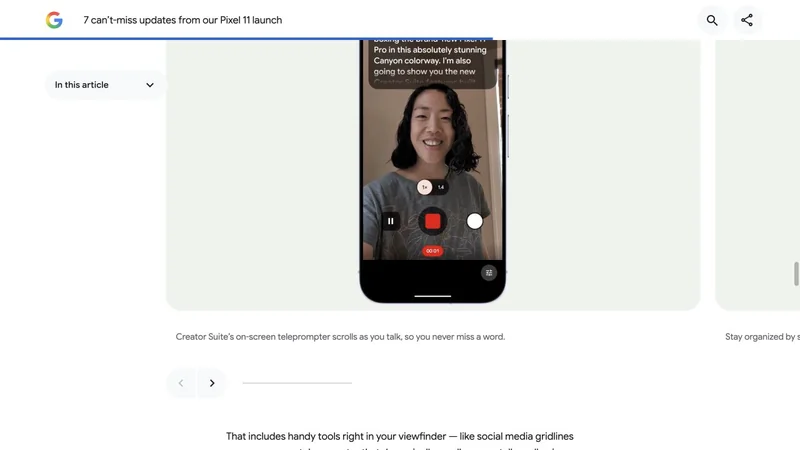
Google is not the first phone maker to experiment with a built-in teleprompter. Xiaomi and Vivo have offered similar tools on some devices. What makes the Pixel implementation notable is its voice-responsive pacing and its place inside a broader recording workflow that continues from filming through clip organization and basic editing. (Android Authority)
The message is clear: scripted selfie videos are no longer a specialized use case.
They are common enough that Google believes the teleprompter belongs beside familiar camera controls.
That is significant validation for a product category that has often been treated as professional equipment—or as a niche utility people discover only after recording the same introduction six times.
Is this the end of teleprompter apps?
For some Pixel 11 owners, the built-in feature may be all they need.
If someone occasionally records a scripted Reel, product update, tutorial, or talking-head video, the convenience is difficult to beat. The script is already inside the camera. The recording controls are already there. The scrolling follows the speaker automatically. There is no second app to configure and no need to move footage between tools.
Google says it designed Creator Suite for people trying to publish frequently without the teams and resources available to major creators. Its camera team specifically focused on helping those users record faster, reduce retakes, and keep their clips organized. (The Verge)
A generic teleprompter whose entire pitch is “put scrolling text over your selfie camera” now faces a serious problem. On the Pixel 11, that experience has become a feature of the phone.
But that is not the same as saying every dedicated teleprompter app has become irrelevant.
It means dedicated apps must now explain what they do better—or differently.
Where Teleflow still has a reason to exist
Teleflow was designed around a narrower, deliberately focused promise: open the app, write a script, choose a readable text size and scrolling speed, and start prompting without creating an account or navigating a complicated production interface. The script, settings, and reading position remain on the device.
Teleflow’s mobile app combines a local teleprompter with optional selfie recording. You can write or choose a saved script, adjust text size and scrolling speed, rehearse in Preview mode without recording, then record a front-camera video with microphone audio when camera and microphone permissions are available. Finished clips can be saved to the device gallery or Photos when saving is permitted. Scripts and settings stay on the device, with no account, backend, or cloud sync required. Prompting remains available with a non-camera background when camera or microphone access is unavailable.
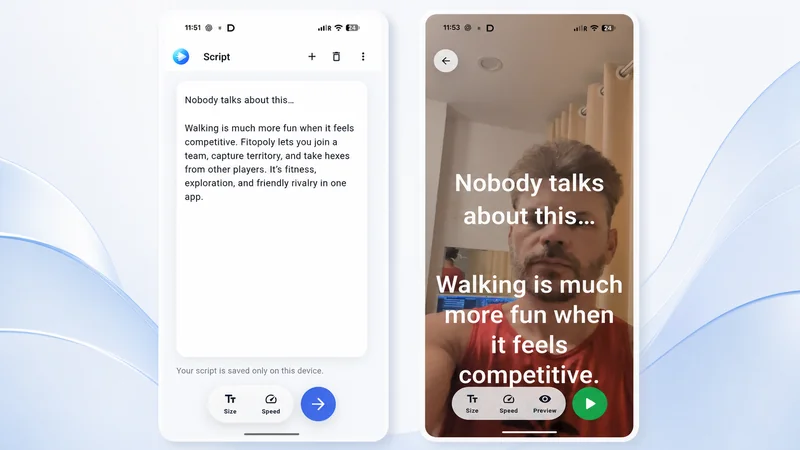
Both products can support a scripted recording. The Pixel comparison therefore turns on Google’s integration with its broader camera and production tools, rather than recording being absent from Teleflow.
Teleflow’s focused approach connects writing, rehearsal, and selfie recording in one local workflow.
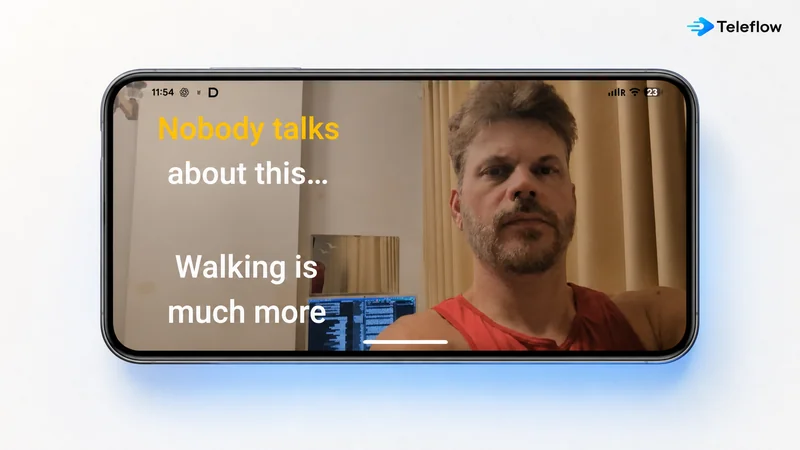
That includes predictable manual speed controls, adjustable text size, a countdown, tap-anywhere pause and resume, preservation of the last reading position, and support for both portrait and landscape playback. It is also intended for iPhone as well as Android rather than being restricted to one new generation of Pixel hardware.
Google’s support documentation says Creator Suite is available only on Pixel 11 and later devices. That leaves older Android phones, non-Pixel Android devices, and the entire iPhone market outside its reach. (Google Pixel Camera Help)
There is also an important distinction around product philosophy. Google’s teleprompter sits inside a growing suite of recording, enhancement, organization, and Google Photos features. Saving videos into Creator projects requires a Google account and automatic Photos backup, although Google does not say that the teleprompter itself requires backup. Teleflow’s promise is broader and simpler: the entire app is designed without an account, backend, or cloud-sync layer. (Google Pixel Camera Help)
For people who actively seek a local-first tool, that difference is meaningful.
The feature Teleflow cannot ignore
The Pixel 11 also changes what creators may expect from a modern teleprompter.
Until now, selecting a scrolling speed before recording has been normal. The creator estimates how quickly they will speak and then tries to keep up with the text.
Google reverses that relationship: the text tries to keep up with the creator.
That is likely to become one of the Pixel feature’s most appealing qualities. It reduces the familiar moment when a speaker pauses for emphasis, loses the script, and has to restart the take.
For Teleflow, there are two defensible responses.
One would be to eventually introduce optional speech-following that runs privately on the device. The other would be to make predictable manual scrolling a deliberate strength: no speech analysis, no unexpected movement, and direct control over exactly how the script behaves.
What would be harder to defend is treating voice-responsive pacing as unimportant. Once creators experience a teleprompter that pauses when they pause, some will begin to see fixed-speed scrolling as a limitation rather than the default.
Teleflow should not become Creator Suite
The wrong reaction would be to copy every feature Google introduced.
Teleflow’s design brief calls for a calm, lightweight creator tool with generous spacing, large tap targets, readable white prompting text, minimal controls, and as little clutter as possible.
Adding clip management, audio meters, editing timelines, filters, cloud projects, social publishing, and AI tools would erase that distinction. Google can integrate more deeply with the Pixel camera, Android, and Google Photos than a small independent app ever could.
Teleflow does not need to win that contest.
It needs to be the tool someone can understand immediately.
Google can own the all-in-one Pixel production environment. Teleflow can keep the path from script to saved take simple: write the words, rehearse them, find a comfortable pace, record over the selfie camera, and save the clip locally.
That positioning is particularly relevant for creators who do not own a Pixel 11, do not want an account, prefer an app whose purpose is obvious, or simply want a standalone prompting surface rather than another content-management system.
Google may have just expanded Teleflow’s market
Native features can hurt undifferentiated apps, but they can also educate the public.
Before this launch, many casual creators may not have thought to search for a teleprompter. They knew they sounded stiff. They knew they kept forgetting lines. They knew recording a 45-second video somehow required eight takes. They did not necessarily know there was a tool designed to solve that problem.
Now Google is explaining that solution for them.
Pixel demonstrations, reviews, social clips, and camera tutorials are showing a much larger audience what an on-screen teleprompter looks like and why it can make recording easier. That increased awareness will not be limited to people who ultimately buy a Pixel 11.
Some will look for an iPhone alternative. Some will want the feature on an older phone. Some will prefer local-only script storage. Others will want a tool that is simpler than a full creator suite.
That is the opening for Teleflow.
A warning—and an opportunity
The Pixel 11 does not make Teleflow irrelevant.
It makes an undifferentiated Teleflow irrelevant.
If Teleflow is presented only as scrolling words over a camera preview, Google’s built-in tool is a direct and formidable competitor. If Teleflow becomes the fastest, calmest, most private, and most widely accessible way to move from written script to confident delivery, then Google has just validated the problem in front of a global audience.
The category has moved from the app drawer into the camera itself.
That raises the standard. It also confirms that the problem was real all along.
For Teleflow, the next step is not to pretend the Pixel 11 feature does not matter. It is to become clearer about why a dedicated teleprompter still does.
Google can build the teleprompter into the phone. Teleflow can make the teleprompter feel like it was built for you.
Teleflow — your words, in flow.
Editorial basis: Teleflow’s recording, microphone-audio, and gallery-save claims were checked against its current mobile implementation on September 6, 2026. Preview mode supports rehearsal without recording. This correction does not establish when recording was introduced or imply that web playback includes the mobile camera workflow.