
Bora Praia
A Sunny Forecast Is Not a Beach Plan
Bora Praia turns weather, tides, daylight, and travel time into the answer beachgoers actually need: when to leave.

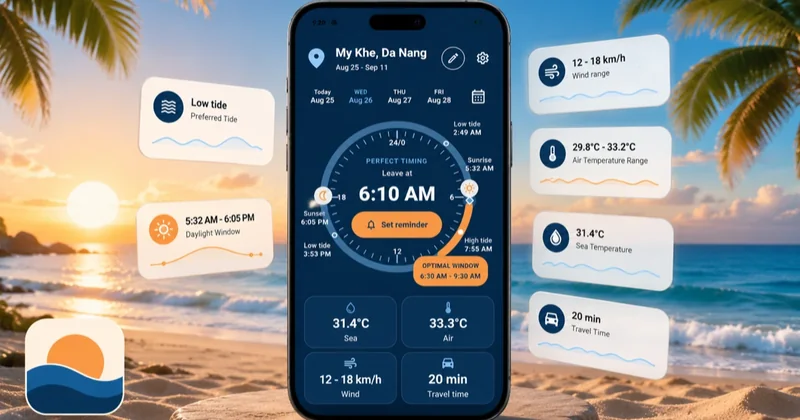
Bora Praia turns weather, tides, daylight, and travel time into the answer beachgoers actually need: when to leave.
Da Nang is having a beach moment. Based on Booking.com search data, the Vietnamese coastal city ranked as the country’s most-searched domestic destination for summer 2026—not only overall, but among families, couples, groups of friends, and solo travelers. The popularity of places such as My Khe also reflects a wider shift in travel: people increasingly want experiences adapted to their own interests, schedules, and routines rather than one-size-fits-all itineraries. (Danang Fantasticity)
But choosing the beach is only the beginning.
Planning the actual day can mean opening a weather app to check the temperature, a tide chart to find the next high or low tide, another forecast for the wind, a map for travel time, and perhaps one more search for sunrise and sunset.
After all that, you may have plenty of information—and still not know when to go.
That is the gap Bora Praia was created to close.
The problem is not a lack of data
Imagine checking tomorrow’s forecast and seeing a large sun icon with a temperature of 31°C.
It sounds perfect. But it does not tell you whether the low tide happens before sunrise, whether the wind becomes uncomfortable halfway through your visit, whether the temperature peaks while you are still traveling, or whether the best conditions end before your family is ready to leave.
A tide chart might show four different events. A weather app might show 24 hourly temperatures. A wind forecast might display speed, direction, and gusts. Maps can estimate the drive.
Each tool answers a different question.
Bora Praia asks the question that comes after all of them:
Given the conditions I care about, how long I want to stay, and how long it takes me to get there, when should I leave?
Perfect Timing starts with your version of a good beach day
There is no universal definition of ideal beach weather.
Someone exploring tide pools may want to arrive near low tide. A swimmer may prefer high tide. A family with young children might prioritize comfortable temperatures, light wind, and enough daylight for a three-hour visit. Someone going for a morning walk may care more about avoiding the hottest part of the day.
Bora Praia begins with those preferences.
Choose a beach, city, landmark, or map location. Select the tide you prefer, the air-temperature range that feels comfortable, and the wind conditions you are willing to accept. Then add your travel time and planned stay duration.
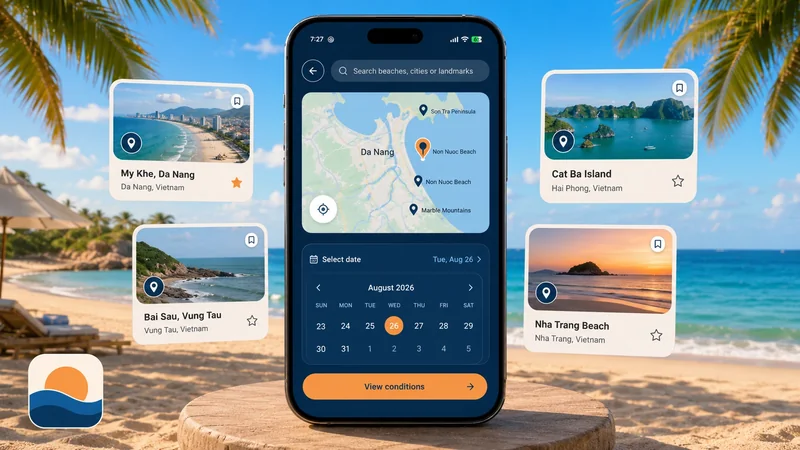
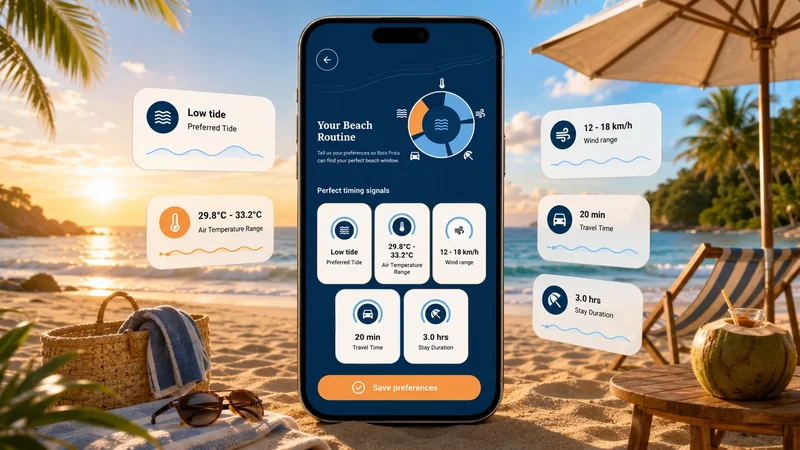
The app compares those choices with available hourly weather, daylight, tides, and marine conditions to find the strongest overlap.
Location matters because tides are highly local. NOAA, for example, provides tide predictions for more than 3,000 individual locations in the United States and explains that accurate predictions depend on data collected and analyzed for a specific station. A tide time from somewhere farther along the coast may not accurately represent the beach you plan to visit. (NOAA Tides and Currents)
Instead of leaving users to interpret several separate charts, Bora Praia converts that overlap into a Perfect Timing plan:
- the recommended outing window;
- the time to leave;
- the tide, weather, and daylight conditions behind the result;
- and an optional reminder when it is time to go.
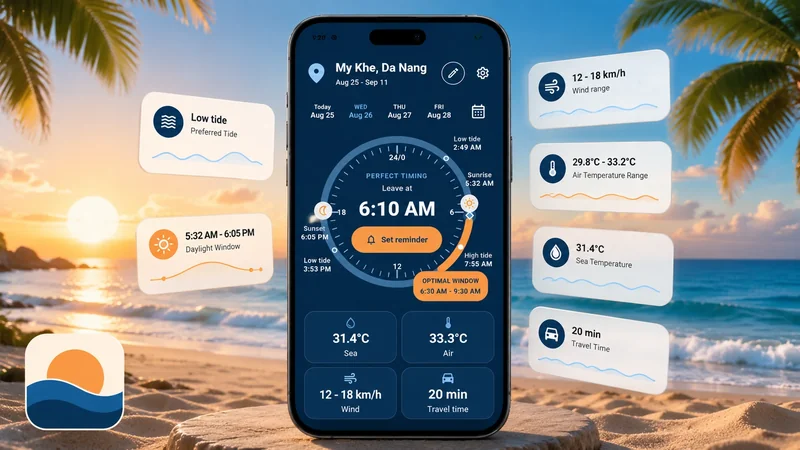
Consider an illustrative morning plan. Low tide occurs at 2:49 AM, sunrise is at 5:32 AM, and high tide arrives at 7:55 AM. You want to spend three hours at the beach and need 20 minutes to get there.
A conventional tide app gives you the tide times. A weather app gives you the hourly temperatures. Bora Praia can turn the combination into something immediately usable:
Optimal window: 6:30 AM–9:30 AM
Leave at: 6:10 AM
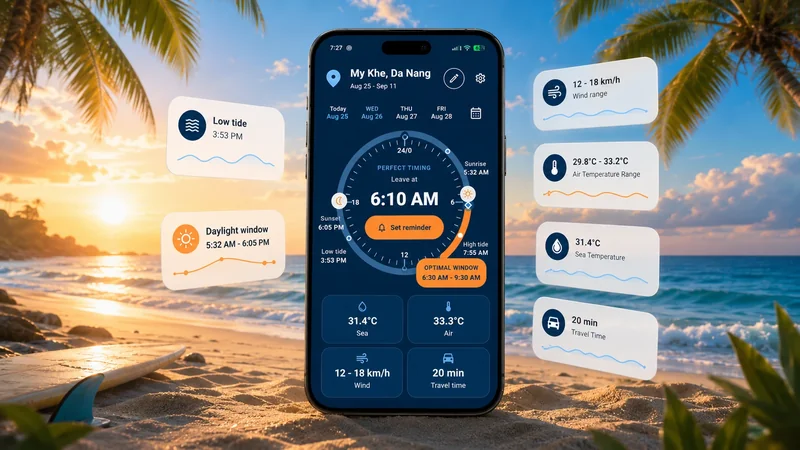
That is the difference between presenting data and creating a plan.
Coastal conditions deserve more than a sun icon
The need for clearer coastal planning is especially visible in 2026.
NOAA reported that the global ocean temperature in July 2026 was the highest recorded for any July. (NCEI) The World Meteorological Organization has also said the developing El Niño is expected to strengthen, increasing the likelihood of heatwaves, marine heatwaves, heavy rainfall, and other weather extremes in different parts of the world. (WMO)
This does not mean every beach visit is dangerous or that a planning app can predict every local hazard. It means a simple sunny-or-cloudy forecast often leaves out important context.
Temperature, wind, daylight, tides, waves, and sea temperature can all shape the experience. The same beach can feel completely different at 7 AM, noon, and late afternoon—even when every hour is technically described as “sunny.”
Bora Praia does not try to replace official safety warnings, beach closures, lifeguards, or local marine guidance. Its role is more focused: help people organize available forecast information around a real outing and make a practical timing decision.
Designed for the way people actually go to the beach
For locals, Bora Praia can make repeat visits easier. Save the places you return to, keep different preferences for each one, and quickly check which upcoming day offers the best window.
For travelers, the app removes some of the guesswork from an unfamiliar coast. Search for a beach or nearby landmark, choose the date you plan to visit, and view the recommendation in the local timezone.
For families, the value is not another detailed chart. It is clarity. A clear departure time makes it easier to coordinate breakfast, bags, sunscreen, children, parking, and the trip itself.
And once a plan is ready, an optional reminder means you do not have to keep reopening the forecast to see whether it is time to leave.
Useful recommendations should also be honest
Weather forecasts are not promises. ECMWF describes medium-range forecasts as probabilistic: they represent a range of possible outcomes, and greater variation among forecast models indicates greater uncertainty. (ECMWF)
That is why Bora Praia is designed to make the state of its information visible rather than presenting every result with false certainty.
Relevant sources, update age, confidence, cached information, and estimated states should be understandable. When available data is not reliable enough to support a recommendation, a clear explanation is more useful than an authoritative-looking departure time built on weak information.
The goal is confidence through transparency—not confidence theatre.
From five checks to one answer
Most beach-planning tools are built around the data they provide.
Bora Praia is built around the decision you are trying to make.
It does not ask users to become amateur meteorologists, interpret tide curves, compare hourly wind speeds, calculate daylight, and work backward from an arrival time. It performs that coordination around the user’s own preferences and presents the result as a simple schedule.
Choose the place.
Choose the conditions.
Add the travel time and the length of the visit.
Then see when to go.
The best travel technology should help people spend less time managing the trip and more time experiencing it. For a beach day, that means checking the plan, packing the bag, and heading toward the water at the right moment.
Bora Praia: Your beach day, perfectly timed. Less checking, more beach.